Social and Emotional Development
- Relationships
- Peers
- Interacts with and develops positive relationship with peers
- Develops special friendships
- Adults
- Develops positive relationships and interacts comfortably with familiar adults
- Peers
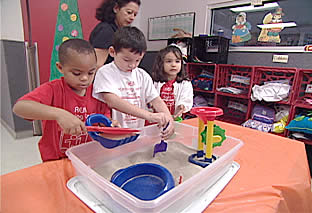 A
positive social and emotional classroom environment is essential for
successful learning. As the teacher you have an essential role in creating
and maintaining a loving and accepting environment. A sense of belonging,
of being a member of the group or the community, plays an important role
in how children approach learning and respond to classroom experiences.
Language, both verbal and nonverbal, helps children feel and express
their emotions, which in turn fosters positive feelings about themselves
and others. One of the challenges young English language learners face
as members of the classroom community is overcoming the barriers created
by their difficulty in communicating. Along the way some children may
show some anxiety, frustration, and lack of motivation to participate.
As they overcome these barriers, children who are English language learners
will feel increasingly confident and secure in their environment.
A
positive social and emotional classroom environment is essential for
successful learning. As the teacher you have an essential role in creating
and maintaining a loving and accepting environment. A sense of belonging,
of being a member of the group or the community, plays an important role
in how children approach learning and respond to classroom experiences.
Language, both verbal and nonverbal, helps children feel and express
their emotions, which in turn fosters positive feelings about themselves
and others. One of the challenges young English language learners face
as members of the classroom community is overcoming the barriers created
by their difficulty in communicating. Along the way some children may
show some anxiety, frustration, and lack of motivation to participate.
As they overcome these barriers, children who are English language learners
will feel increasingly confident and secure in their environment.
The following are ranges of emotions a child may feel as he/she becomes a secure part of the classroom community.
 |
I'm glad to be me! |
 |
I belong here! |
 |
I have lots of friends! |

